Saturday, 10 January 2015

Interview - Rjurik Davidson

Hi Everyone,

I am stoked to be able to bring you the next interview in our series on Australian speculative fiction writers. Rjurik Davidson, author of Unwrapped Sky (one of my favourite books of 2014), took time out of his busy schedule to chat with Smash Dragons about himself, his work (past, present, and future), and the craft of writing. 

Rjurik Davidson, welcome to Smash Dragons! Tell us about yourself, and your novel Unwrapped Sky.

I’m a writer, editor and speaker. Unwrapped Sky is a novel of love and revolution, loyalty and betrayal, myth and technology. Caeli-Amur is an ancient city perched on white cliffs overlooking the sea. It is a city in crisis. When minotaurs arrive for a festival, three people’s lives fall apart as the city erupts into revolts. Some people think it’s a bit like China MiĆ©ville, others like Jack Vance or Gene Wolfe. I’d be happy if I lived up to any of those.

Why did you become a writer? Who are your literary influences?

I started writing as a child, stopped for a while, returned to it in my early twenties. At sixteen I wanted to be in a rock band. Not unusual for a teenage boy, but later on I played with some really good musicians and as Dirty Harry says, “A mans got to know his limitations.” There was a period there in my late teens, early twenties when I sort-of drifted around directionless. But slowly I settled on writing. It was a calling from the beginning, even if I ignored it for a while. From then on it’s been fairly steady as a writer, I suppose, though I haven’t been wildly prolific. A lot of my writing has been non-fiction: people can read some of that on my website. I’ve probably got a book’s worth of essays, not counting online pieces. Maybe someday someone will want to publish a book of those. Anyway, I’m someone who crosses genres and modes. I’m not just a fantasy writer, but also write SF, surrealism, magic-realism. I’m not just a fiction writer, but write essays, screenplays, and am planning a non-fiction book. I don’t think of any of these as separate in any way. In my head, they’re all part of the same project.

I’ve been thinking a lot about influences lately. Sometimes the people who influence you the most aren’t necessarily those you think are your influences. I’d like to be influenced by Le Guin, Ballard, Philip K. Dick, but I’m not sure how much I am. You can find a bit of Ballard in the ruined landscapes of Caeli-Amur, a bit of Le Guin in the questions of politics, a bit of Dick in the way certain characters lose it. I think you can find traces of Peter Carey, Samuel Delany, the realist writers (Tolstoy, Zola) and others in my work too. It’s all a kind of mish-mash in the end, though. My favourite writers include Hilary Mantel, Anton Chekov, Jorge Luis Borges, Peter Carey, Jean Paul Sartre, Virginia Woolf, James Ellroy. Inside SF, I tend to like the New Wave writers: Thomas Disch, J. G Ballard, M. John Harrison (who’s really a post-New Waver writer nowadays and whose recent work is brilliant), Samuel R. Delany, Ursula K. Le Guin and Joanna Russ. 

You’re an interesting case in that you have worked both as a writer and an editor.  How has this helped shaped your craft?

I have a lot more respect for editors than I ever did before! Poor things. It does demystify the process though. I’ve worked as an editor in a ‘literary’ publication and some film magazines, and so that also gives me a perspective from outside the speculative fiction world. That’s good to have, though sometimes I feel like a bit of an outsider in both worlds. It’s also taught me that though we’re all ‘experts’, it’s pretty hard to predict which pieces will resonate with readers. Yes, we generally know the good pieces from the bad, but every now and then we’re really surprised by the things readers love and unnerved by the things they hate. It’s hard to predict. 

Tell me about the genesis of Unwrapped Sky. Was it one of those light bulb moments or a long process of creation and evolution? 

The idea for Unwrapped Sky came many years ago. Initially I wanted to write a story where the magicians of a city were oppressed. It would be a story of their liberation. At the time I didn’t know quite how to write it, so it sat in my notebooks for ages. The initial impulse for the world of Caeli-Amur came from reading a New Wave writer, Samuel R. Delany. There’s a scene in The Einstein Intersection, one of his ‘science fantasy’ books, with an underground ruined bunker of some sort. The opening of the novel read like fantasy, then suddenly there was this ancient ruined technology and I thought, “Whoah, what’s this?” I then went to Clarion South writers’ workshop and wrote a broken story set in Caeli-Amur, which emerged in a white-hot week. Michael Swanwick was the tutor that week and gave it a ‘Swanwicking’, which I was all the better for. When I returned to Caeli-Amur, it was waiting for me. Suddenly I knew how to write that novel about the oppressed magicians, though it turned our quite different from how I imagined as a twenty-year-old.


I’ve always been curious (as a historian and teacher) as to how much research goes into writing a novel. Brian Staveley talks about being caught up researching interesting little tidbits, such as how far a man on a horse can travel in a day. Was this the case when you were writing Unwrapped Sky? 

That’s about it. I try to get all those technical things right. The other one is to call things by their right names. It basically involves a lot of looking things up: “What do you call the back raised deck on a boat?” 

Unwrapped Sky is a novel that spans across many different genres, with elements of fantasy, new weird, and steampunk evident throughout. Was it challenging writing a novel that crossed over so many different literary foundations?

Part of the challenge was to create a sense of cohesion to work with the surprise that comes with genre merging. How do all these elements work together? How do you make sure it doesn’t feel like it’s just all thrown in non-sensibly? I didn’t want to fall into the mistake of over-explaining. The real world isn’t like that. We wander through without much idea about the history of the things around us – without much about them at all. I wanted a sense of that in the novel. I wanted the readers mind to go on wild flights trying to fill in the gaps. If anything, Unwrapped Sky probably leaves a few too many things a mystery, but the next novel The Stars Askew clarifies some of them, and introduces other mysteries. 

There are some fascinating and thought provoking concepts in Unwrapped Sky, ranging from an examination of revolution and power through to class warfare and the notion of love and identity. I remember being stunned by its breadth and scale. Was it your intention to try and write your novel this way?

I want my novels to be rich, complex, thoughtful. I want them to be about something. If you’re going to spend a year or more on a novel, they should be about something. I took some of my attitude from the realists, I suppose, who try to use their novels to capture a sense of history itself and the forces that drive it. So you try to have characters crossing the different strata of your world. Take a factory worker like Boris Autec and shove him up into the world of the elites. That way you get to see both sides of the world. See how the elites live, but show how the poor do too. When I was about 13 years old I read Tolstoy’s War and Peace, which is an absurd and brilliant book. I remember there being pages and pages of authorial comment and historical theorization. It seemed to be about almost everything! You couldn’t get away with it now, but it seemed an amazing way to write a book. I hope you get a bit of that sense in Unwrapped Sky. 

I adored the characters in Unwrapped Sky. I thought your ability to make me experience a range of emotions (for example anger, yet understanding and sadness at the words and actions of Boris) on every single page was one of the highlights of the book. Who was your favourite character to write, and why?

Kata is really the hero of the story, and I’ve a pretty big soft spot for her. Max thinks he’s the hero, but comes to realize he’s not. He has an arrogance that I don’t care too much for. But Boris was probably my favourite, and in a sense I think the most original. He rises, but his rise is a moral fall. I think he’s more complex than Max, probably. My challenge was to make us empathize with Boris, even though we know he’s turning bad. 

Whilst reading Unwrapped Sky I was struck at how horrifying and yet fasciating the Elo-Talern were. Will we learn more about them and their origins in the next novel?

Indeed we will. The Stars Askew will unveil more of their history, and complete their story. Elo-Drusa is waiting for readers with her flickering, horse-like head.

As a magic system nerd I found the system of thaumaturgy in Unwrapped Sky utterly fascinating. I especially loved how you incorporated a big element of risk and cost in using it. How did you come up with it?

As I was writing, I was reading about quantum theory, and multiple universes, and these made their way – in very mediated configurations – into the form of thaumaturgy. Perhaps the most obvious gesture is that at the beginning of Unwrapped Sky thaumaturgy is fragmented into discrete disciplines. Each discipline has its own set of formulae and equations. So thaumaturgy is fragmented and the character Max is searching for a unified theory, a “theory of everything.” When you use it, it poisons you, a little like magical radiation. So there’s a real sense of thaumaturgy as a met
aphor for science. But they’re metaphorical gestures. Thaumaturgy is scientific in the world of the novel. It’s not our science though.

Caeli-Amur is described with such life and depth that I actually felt like I was there wandering the city as events in the novel unfolded. What historical influences inspired your creation of it?

I’d say it’s a series of combinations merged into its own entity. It’s a bit of Ancient Rome, a bit of Paris in the 8th and 19th Century, a bit of Russia at the turn of the 20th Century. But of course it’s none of those either. Caeli-Amur is its own city with its own original things too.

You’ve been selected, along with 199 others, to colonise Mars. Due to weight restrictions you can only take 3 hardcover books. What titles are they, and why?

1. War and Peace, because it’s massive and very, very complex. I could reread it several times, I think.
2. Le Guin’s The Left Hand of Darkness. To my mind, the greatest of SF novels.
3. My own little collection, The Library of Forgotten Books. There’s nothing like rereading one of your old stories and being surprised: “Did I write that?!”

What are you currently working on? What can readers expect in the future?

The Stars Askew is off to the editors. I’ve pretty much finished up with The Rusted Earth, which is gaslight fantasy. The main character is a suffragette librarian – Eugenie Healy – who works at the National Museum in Melbourne. In this alternate Australia, there is still an inland sea and much of the megafauna – giant lizards and diprotodons (giant wombat-like mammals) – still survives. Readers of my story ‘Int. Morgue. Night.’ (from my collection The Library of Forgotten Books) might recognize this setting, though the action in the novel takes place in the 1890s, not the 1950s. As a result of the sea, there has been a massive influx of migrants. Readers can expect to encounter opium dealers and spiritualists, Chinese junks sitting in the harbour, industrialists in the halls of a powerful men’s club, a rural utopian community who have rejected the modern technologies, the hideout of one of the last bushrangers, a ruined ancient city in the desert – and automatons, of course. I’m also working on a bunch of new short stories. I really want to get back into story writing.

What do you think about the current state of speculative fiction in Australia? Are there any local writers you would recommend to fans of Smash Dragons who are on the rise?

Australian Speculative Fiction is powering on. It’s still a small community, but a vibrant one. Sometimes I wish it were better known in the mainstream, and better known overseas. There are writers breaking out onto the international stage. Some include: Angela Slatter, Lisa Hannett, Ben Peek, Mark Barnes. I’m very keen to read James Bradley’s Clade, which I predict will be a phenomenon. Twelfth Planet Press and Coer de Lion press are both bringing out great stuff. 

Finally, will you be attending any book signings/events in 2015?

I’ll be around Australia more, but I’m not sure at the moment.

Rjurik Davidson, thank you for taking the time to chat with Smash Dragons!

Thanks for having me.


You can purchase Unwrapped Sky online or at at all good book retailers. It is one of the most fascinating reads I've had in years, and I implore you all to go out and get yourself a copy. 

Stay tuned for next week, when Smash Dragons interviews Ben Peek. And remember peeps... reading is cool! 

Book Review - Firefight by Brandon Sanderson

Firefight, the action packed sequel to Steelheart, delivers on its promise and is a great follow up that once again pits the Reckoners against the all powerful Epics. 

The elimination of Steelheart, and the freeing of Newcago, has not made David's life more simple. Instead, it has raised big questions. The answers he is seeking to those questions lie in Babylon Restored, ruled by the mysterious Epic Regalia. When an Epic attack is revealed to have originated from Babylon Restored, David, Tia, and the Professor travel to there to take down Regalia, and to find Firefight, who may hold the key to the mystery of Calamity and the Epics. 

Firefight is a roller coaster ride of action, entertainment, and humour. Like in Steelheart, Sanderson has crafted a tale that is easy to read and yet complex and rewarding. David, his main protagonist, is still the awkward and loveable geek whose ability to inspire and influence his fellow Reckoners has continued throughout this book. He still loves Megan (Firefight) and it is his relationship with her that is arguably the most revealing as they both attempt to build a discourse between normal humans and Epics. Firefight builds on the notion (as suggested in Mitosis) that the weaknesses of the Epics are personal and linked to past trauma, and as the Reckoners attempt to take down Regalia we are drawn into the complex web of questions regarding the origins of the Epics and their power. Sanderson takes the reader on many twists and turns throughout the story, and his climax at the end of Firefight was amazing and very satisfying. The action and training scenes were, as in Steelheart, highly entertaining and at times extremely funny (David's clumsiness made me laugh out loud at times!), and I found the planning and discussion in relation to taking down Regalia and the other Epics fascinating and creative. Sanderson's introduction of new characters, such as the loveable Mizzy, worked well enough, but I did find myself missing some of the old members of the Newcago crew like Abraham. Sanderson also handles the budding romance between David and Megan really well, and I found myself smiling at their teenage like antics throughout the story. 

Overall Firefight is a fun and cracking tale of the underdogs going up against a seemingly all powerful enemy. Fans of Sanderson and Steelheart will not be disappointed, with the climax leaving things positioned brilliantly for the next book, entitled Calamity. 

A must read for all fantasy and young adult fans!

4 out of 5 stars.

smashdragons.blogspot.com.au 

Note - A review copy was provided.

Friday, 9 January 2015

Book Review - The Deep by Nick Cutter

Woah... i'm still breaking out in cold sweats just thinking about this one... originally I had this one rated at 3.5 but I've upped it to 4 because... well... I can't get it out of my head! 

When a disease known as the 'Gets' ravages humanity, the world comes together to research a mysterious substance on the floor of the Marianas Trench that may hold the key to our survival. When one of the scientists at this underwater installation requests his brothers help just before contact is lost, that brother has no option but to descend to unknown depths to confront a nightmare. 

Ok... this book is terrifying. There, I said it. I like to think of myself as someone who could handle most things. Spiders... check. Snakes... check. Bugs... check. Trapped in a facility over 8 miles down with unspeakable horrors that like to toy with me physically and psychologically. Oh fuck no! The Deep is like a bad nightmare that you just can't wake up from. As I read it I felt tormented (and yet I couldn't put the book down!) by what was happening before me. Cutter has somehow managed to tap into the most basic primal fears and weaknesses of the human mind and tipped them upside down and stomped on them. After turning the final page I literally had take a time out lasting hours to compose myself from the emotional grinder I had just been put through. The Deep harks back to a golden age of horror from the 80s and 90s... King was at the top of his game... and we were all too scared to go to sleep... or associate with clowns (I still don't like clowns!). There are many elements in this novel that reminded me of classics like The Abyss, The Thing, The Sphere, and Alien. Cutter wields them an expert hand (hard to believe this is only his second novel!), screwing with the readers mind to such a point that you feel like you're there with Luke as he suffers. Whether it's the deep sense of claustrophobia, creepy flashbacks, hopelessness, or horror, The Deep just slams into your psyche like a freight train without brakes. And just when you think you have a handle on it all, Cutter decides to manically laugh (well I'm just imagining this, but I bet he did!) and veer off into a realm of creepy Lovecraftian weird that just blew my mind. His characters are well fleshed out (oh the irony of that sentence!), and I felt a yawning sadness for Luke (and to a lesser extent his brother) as they danced with the dark horror beneath the waves. I also really enjoyed how Cutter also structured this book. The flashbacks were interesting and horrifying and they added a dark depth to the overall plot. 

The Deep is one of those stories that you will literally lose sleep over. You will either read it in small snippets because that is all you can handle at a time, or you will be so caught up in the horrible mess that is unfolding inside your brain that you will not be able to put it down! A must read for horror fans! King has a new challenger to his title.. and I suspect Cutter will take it sometime very soon! 

4 out of 5 stars.

smashdragons.blogspot.com.au

Thursday, 8 January 2015

Book Haul and Update

Hey peeps!

An amazing book haul this week here at Smash Dragons... I received a review copy of Firefight by Brandson Sanderson (thanks Hachette Australia)... Gollancz mailed me my competition prize of a signed HB of Words of Radiance and bonus PB copies of The Way of Kings part 1 and part 2... and I purchased John Birmingham's latest novel entitled Emergence.

I also received galleys of John Joseph Adams's Operation Arcana and Karen Lord's The Galaxy Game. I cannot wait to dive into all of these titles! In blog news I can reveal that Smash Dragons will be featuring interviews with Australian authors Rjurik Davidson and Ben Peek over the next week or so. I've got an interview with Alan Baxter lined up, I am also hoping to secure an interview with Glenda Larke (if your reading this Glenda, pretty please?) in the near future. So exciting times ahead!

What books have you got in your haul this week?

Would love to hear from you... please feel free to drop me a line!

Book Review - The Godless by Ben Peek

I must admit that I passed up on purchasing The Godless when it was first released. Something about the blurb deterred me at the time. In hindsight that was a very stupid decision on my part, and I'm glad that I changed my mind and raced to the store to pick a copy to read over the holidays. 

The Godless tells the story of many fallen gods whose bodies lay strewn across the world after their cataclysmic war. Their power has not fully diminished however, and it inhabits certain individuals from time to time, gifting them unusual powers and extended life. One such person, Ayae, finds herself 'god-touched' and drawn into a complex web of politics, war, betrayal, and destruction that will result in enemies and death no matter what. 

So what did I love about The Godless? Many, many things. First up I found the world Peek created in The Godless to be utterly immersive and massive in breadth and scale. It was wonderful, for example, to read about how the merchant city of Mireya lies atop of the crystallised spine of the god Ger. And that if you tunnel down into the mountains you are basically tunnelling through Ger's carcass. I also adored how Peek stomped on well used tropes (white male heroes for example) by embracing diversity and equality throughout the novel. The Godless features many different and fascinating characters (especially powerful women... which is bloody awesome!), from the fire wielding Ayae and strange Zaifyr through to Lady Waggan and the nefarious Bau and Fo. I was mesmerised by them all, especially Zaifyr, whose history and depth (not to mention his many mistakes and corrupted soul) blew my mind. Secondly I loved the ideas and concepts explored in the Godless. History, power (and its ability to corrupt), religion, and the notions of good and evil are all touched on and examined throughout the novel. This really added to my enjoyment, and I loved how Peek explored and picked each of them apart (Peek's style and exploration of ideas reminded me a lot of Rjurik Davidson's Unwrapped Sky... which I loved as well) as the story unfolded. Finally, I loved how Peek let the story evolve and unfold. I cared about what was happening, and I was on the edge of my seat reading late into the night as armies laid siege to cities, and magical and supernatural battles played out. This to me was fantasy at its best... challenging... yet also adventurous and full of intrigue and high stakes. 

If I had one small criticism (and it is a very very small one) it would be that I perhaps wanted a little more background as a reader before I was thrown in at the deep end at the start of the book.

All in all I really enjoyed reading The Godless. I found it to be an original, fascinating and bloody enjoyable work that all fans of fantasy should read! One of my reading highlights in recent years! 

4 out of 5 stars.

Wednesday, 7 January 2015

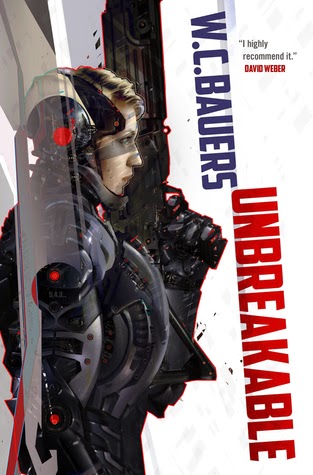
Book Review - Unbreakable by W. C. Bauers

Interesting is the word that springs to mind when describing Unbreakable. As a massive fan of military science fiction, I had high hopes for Unbreakable. Did it deliver? Yes... mostly.

Unbreakable tells the tale of Promise Paen, the leader of Victor Company of the RAW (Republic of Aligned Worlds) Marines. When events take her and her marines back to her home planet, she is embroiled in a brewing and impending interstellar war.

Unbreakable starts out slow, but quickly escalates into an action packed, balls to the wall, military sci fi. Fascinating characters, sprawling space politics and rivalries, cracking battles and awesome tech make Unbreakable a really good read for fans of the genre. Comparisons with other favourites are inevitable, and titles like Aliens, Old Man's War, and Starship Troopers will be brought up when describing Unbreakable. And yes... there are similarities between them all. This brings me to my small problem with Unbreakable... at times it felt like I had already read something similar before. For example, Promise Paen at times resembles a female Johnny Rico... and whilst that didn't detract much from my overall reading experience I just felt Bauers could have pushed the boundaries a little more and changed things up from deploying well used tropes (I concede Robin Hobb's point though that tropes become tropes because we love them!).

Did this ruin Unbreakable for me? No. I still loved it, and would recommend it to anyone with even a small interest in science fiction or speculative fiction. A very solid debut!

4 out of 5 stars.

smashdragons.blogspot.com.au

Sunday, 4 January 2015

Book Review - Obsidian by Alan Baxter

Alex Caine returns in this bloody good adventure and follow up to Bound. Obsidian finds Alex and Silhouette looking for purpose and direction in their lives. When they are recruited by a mysterious organisation to combat evil magic, they find themselves transported and trapped in an alternate realm and city where magic, monsters and death lurk around every corner. 

Like in Bound, I really enjoyed the easy and action packed style that Baxter writes with throughout the story. It is a fast paced, balls to the wall style that works extremely well alongside his characters and plot. I thought the fight scenes were well choreographed (again, like in Bound) and written, and I was fascinated by Alex's growth and direction throughout the story. I also adored how Silhouette grew from the first novel, becoming even more complex and interesting. The introduction of new organisations and characters also worked well overall in setting things up nicely for future books (although I thought the introduction of new character Claude Darvill was cliched initially, I soon found myself just enjoying his role in the book). I will admit I did a little dance when Black Diamond returned! 

I also loved the elements of horror that Baxter brought to this book. The monsters were both exhilarating and creepy, and Obsidian itself was fascinating. If I had one small criticism it would be that I wanted more monsters and more fight scenes!

All in all Obsidian is a very worthy follow up to Bound. It is dark, creepy, and action packed. I cannot wait to read the next book in the series. If you love dark urban fantasy or horror then Obsidian is the read you are looking for!